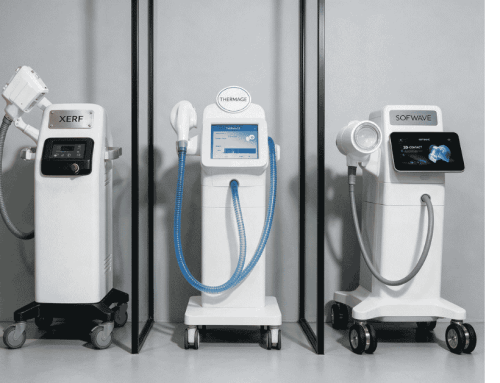
Both laser hair reduction and electrolysis are marketed as “permanent” hair removal, but they work through entirely different mechanisms and suit different patients. The right choice depends on hair colour, hair density, skin tone, and how much time a patient can commit — not on which technology sounds more advanced.
How Laser Hair Reduction Works
Laser hair reduction uses a concentrated beam of light that is absorbed by melanin — the pigment in the hair shaft and follicle. The absorbed light converts to heat, which damages the follicle’s ability to produce new hair. Because the laser targets melanin specifically, it works best on hair that has significantly more pigment than the surrounding skin: dark, coarse hair on light-to-medium skin is the ideal combination. On Indian skin — typically Fitzpatrick IV to V — results are still strong, but the treatment protocol (wavelength, cooling, spacing between sessions) has to be adjusted to protect the surrounding melanin-rich skin from heat damage. Laser only works on hair in the active anagen (growth) phase, since that’s when the follicle holds enough melanin to absorb the light — and only a portion of the hair in any treated area is in anagen at a given time. This is why sessions are spaced four to eight weeks apart: each one catches a fresh batch of hair as it cycles into anagen, rather than one session clearing everything at once.
How Electrolysis Works
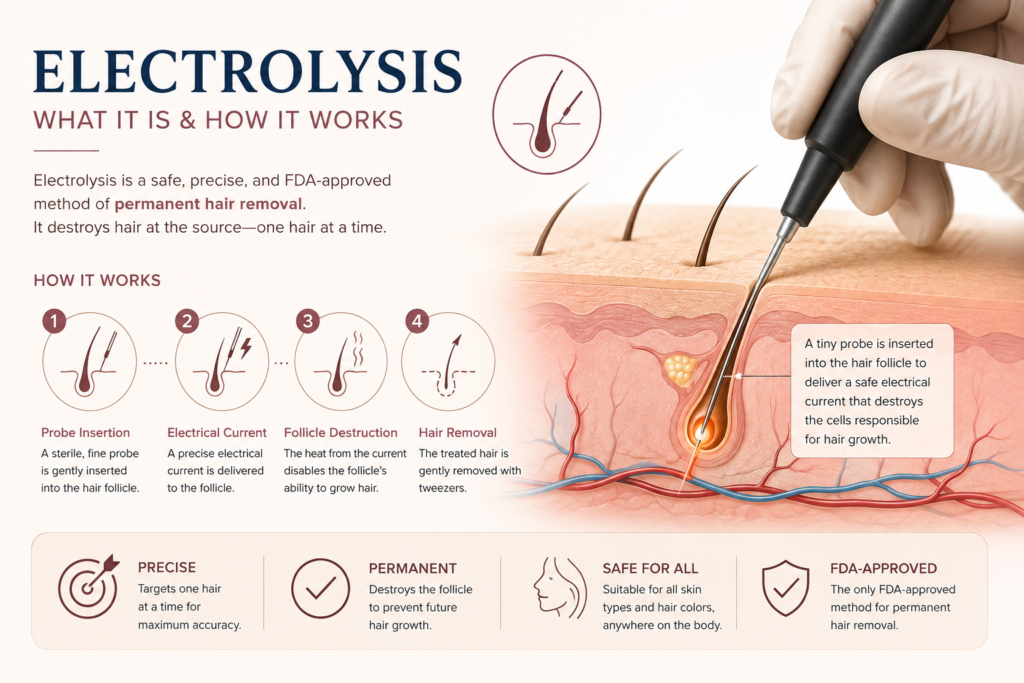 Electrolysis works on the follicle directly rather than on pigment. A fine probe is inserted into each individual hair follicle, and a small electrical current destroys the follicle’s growth cells — either through heat (thermolysis), chemical reaction (galvanic), or a combination of both. Because it doesn’t rely on melanin contrast at all, electrolysis is colour-blind to both hair and skin: it works equally on white, grey, blonde, or red hair, and on any skin tone, which laser cannot do reliably. Electrolysis is largely independent of the hair growth cycle, since the probe treats the follicle regardless of what stage it’s in. Repeat sessions are still needed, though — not every follicle responds fully the first time, and some regenerate partially even after apparently successful treatment. The core distinction that should drive the decision, not brand claims: laser reduces hair growth across an area; electrolysis eliminates hair follicle by follicle.
Quick Comparison
| Factor | Laser Hair Reduction | Electrolysis |
| Best suited for | Dark, coarse hair on light-medium skin (adjustable for Indian skin) | Any hair colour, any skin tone |
| Speed per session | Fast — covers large areas (legs, back, full arms) in minutes | Slow — follicle by follicle, small areas per session |
| Sessions needed | 6–8 typically, spaced by hair growth cycle | Multiple sessions over months, varies widely by area |
| Permanence | Significant, long-term reduction; occasional maintenance | Considered truly permanent when done correctly |
| Discomfort | Mild heat/snapping sensation, cooling reduces this | Mild sting per follicle, cumulative over a session |
| Ideal areas | Large areas — legs, underarms, back, bikini line | Small, precise areas — eyebrows, chin, upper lip, isolated stray hairs |
Why Hair and Skin Type Decide the Answer
The single biggest factor is hair colour relative to skin tone, not personal preference.
- Dense, dark, coarse hair on medium-to-dusky skin: high melanin contrast, so laser works efficiently across large areas in a handful of sessions — the profile most Indian patients treating legs, underarms, and the bikini line fall into.
- Fine or light-coloured hair: laser has little melanin to target, so electrolysis becomes the better — sometimes the only — option.
- Isolated stray hairs (chin, upper lip, ingrown sites): electrolysis offers precision laser can’t match. It’s impractical for large areas, though — treating a full leg follicle by follicle would take an unreasonable number of sessions.
- Pigmentation risk on Indian skin: laser carries a higher risk of post-inflammatory pigmentation if parameters aren’t adjusted for melanin density — a settings and protocol issue, not a reason to avoid laser. Correct wavelength selection (typically Nd:YAG for deeper skin tones) and adequate cooling keep it safe and effective. Electrolysis carries this risk to a much lesser degree, since it doesn’t rely on light-based heat spreading through the skin.
- Tanned or sun-exposed skin: narrows the hair-to-skin contrast laser depends on, raising the risk of affecting surrounding skin rather than just the follicle — most protocols recommend avoiding sun exposure for two weeks before and after each session. Electrolysis isn’t affected by tanning the same way, though sun-sensitised skin still needs the same general aftercare.
Cost and Time Investment
Cost comparisons between the two are often misleading because they measure different things.
- Laser: priced per session per area, on a defined course — most patients finish initial reduction in 6 to 8 sessions, after which cost is largely fixed except for occasional maintenance.
- Electrolysis: billed per session in shorter time blocks, since only a limited number of follicles can be treated per sitting. Timelines extend over months for any area larger than a few square centimetres, so treating something like a full leg with electrolysis alone costs substantially more than the equivalent course of laser.
In practice, the two rarely compete on cost directly — the hair-and-skin combination decides what can even respond, and cost follows from that, not the other way around.
What to Expect After a Session
Aftercare differs slightly between the two, though both are minor and short-lived when the procedure is done correctly.
- After laser: mild redness and follicular swelling around treated hairs for a few hours to a day, similar in appearance to a mild sunburn or heat rash; sun protection is essential for the following two weeks given the pigmentation risk.
- After electrolysis: tiny pinpoint marks or slight redness at each treated follicle, typically resolving within a day; keeping the area clean reduces the small risk of local irritation at puncture sites.
- Neither should leave lasting marks when performed at correct settings by a trained provider — persistent redness, blistering, or pigment change beyond a few days should prompt a follow-up with the treating dermatologist, not be written off as normal healing.
What to Actually Do
- Large areas, dark coarse hair, medium-to-dusky skin: laser hair reduction is the more efficient and cost-effective choice.
- Small, precise areas or stray hairs — eyebrows, chin, upper lip: electrolysis offers cleaner, targeted control.
- Fine, light, grey, or white hair anywhere on the body: electrolysis, since laser has little melanin to target.
- Time and budget constraints: laser requires fewer total appointments for large areas; electrolysis requires a longer-term commitment but treats areas laser cannot.
- Either treatment should be performed by a qualified dermatologist or trained technician under medical supervision — at-home devices and unsupervised clinics carry real risks of burns, pigmentation, and incomplete follicle destruction that leads to regrowth.
Frequently Asked Questions
Is laser hair removal actually permanent?
Laser produces significant, long-term hair reduction rather than permanent elimination in most patients — hair that regrows is typically finer and sparser. Occasional maintenance sessions, especially around hormonal changes, are common even after a full initial course.
Is electrolysis painful compared to laser?
Electrolysis involves a small sting per follicle that can feel more concentrated since each hair is treated individually, while laser delivers a broader heat sensation across an area with cooling to offset it. Most patients tolerate both well, and topical numbing can be used for either.
Can laser hair removal cause dark spots on Indian skin?
Post-inflammatory pigmentation is a real risk if the wrong wavelength or settings are used on melanin-rich skin, which is why protocol selection matters more than the technology itself. With correctly calibrated Nd:YAG lasers and proper cooling, this risk is low and manageable.
Does electrolysis work on grey or white hair?
Yes — because electrolysis destroys the follicle directly rather than targeting pigment, it is one of the few treatments that works reliably on grey, white, or very light blonde hair, where laser has little to no melanin to target.
How many sessions does each treatment need?
Laser typically requires 6–8 sessions spaced to catch hair in different growth-cycle phases, while electrolysis timelines vary widely depending on the area and number of follicles, often extending over several months of regular visits.
Can I combine laser and electrolysis?
Yes, and it’s a common approach — laser to clear large areas efficiently, followed by electrolysis to finish off any finer or lighter hairs the laser couldn’t fully target. A dermatologist can map out which areas suit which technology.
Book a consultation: wa.me/919381218003
— Dr. Nishita Ranka | Consultant Dermatologist | Dr. Nishita’s Clinic for Skin, Hair & Aesthetics, Hyderabad