Most people asking about Botox and fillers use the two words almost interchangeably, like they’re just different brand names for the same thing. They’re not. They work on completely different parts of your face, through completely different mechanisms, and mixing them up is usually what leads to disappointment, either the lines you wanted softened are still there, or the volume you wanted restored never showed up, because the wrong treatment was picked for the job. Here’s what actually separates them, without the marketing language.
Botox: It Relaxes, It Doesn’t Fill
Botox isn’t a filler at all. It’s a purified protein that temporarily relaxes the specific muscles responsible for certain facial movements. Most expression lines, the ones on your forehead, between your brows, or around your eyes, form because a muscle contracts the same way thousands of times over the years. Botox softens those lines by reducing how much that muscle can move, not by adding anything underneath the skin. That’s why Botox works so well on what dermatologists call dynamic lines, the ones that show up when you frown, raise your eyebrows, or squint. It does very little for lines that are already etched into the skin at rest, called static lines, since there’s no muscle movement left to relax. Results usually show up within three to seven days and last three to four months, after which the muscle activity gradually returns and the treatment needs to be repeated to maintain the effect.
Fillers: They Add Volume, They Don’t Relax Anything
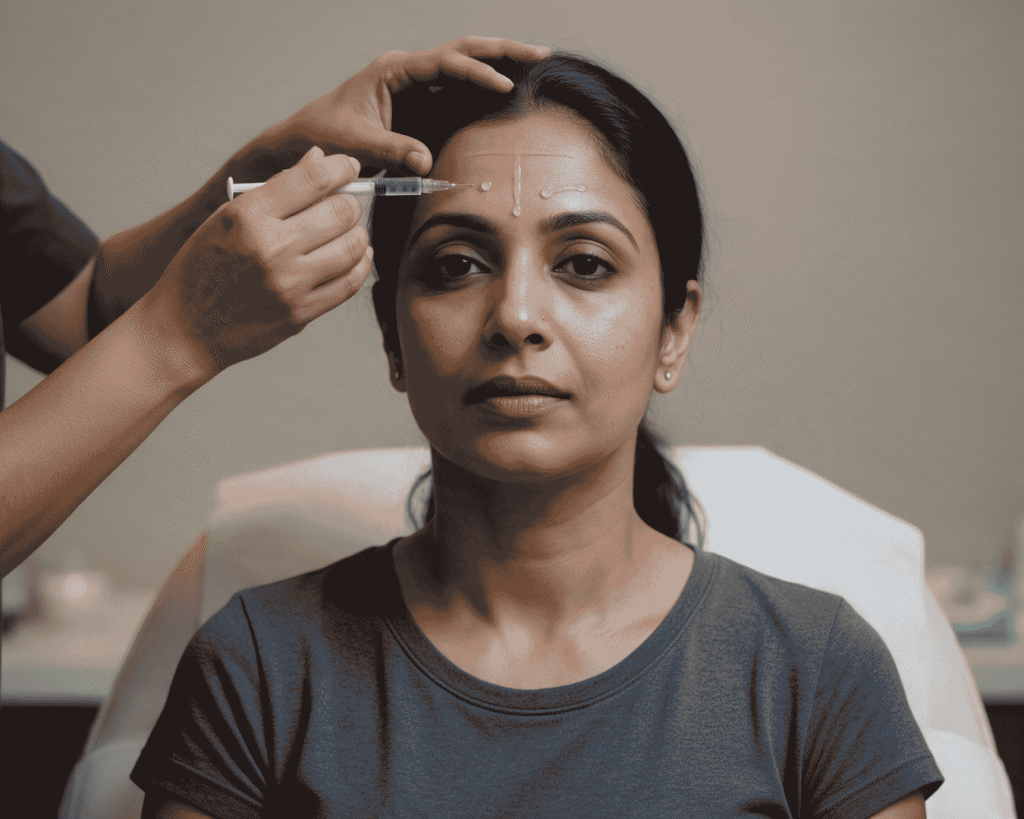
This makes fillers the better choice for concerns like hollow cheeks, thin lips, a receding jawline, or the deep folds that run from the nose to the corners of the mouth, none of which are caused by muscle movement, so Botox wouldn’t touch them. Results are visible immediately after treatment, and depending on the product and area, typically last anywhere from nine months to two years.
Why the Confusion Happens
Both are injectable, both are done in a quick in-clinic visit, and both are often mentioned in the same breath as “anti-ageing treatments,” which is probably why people assume they’re variations of the same idea. But the honest way to think about it is this: Botox stops a muscle from moving too much. Fillers put back what the skin has lost. Neither one can do the other’s job. This is also why the same face can genuinely need both, treated together but for entirely different reasons. Someone might need Botox for forehead lines and filler for hollow under-eyes in the same sitting, and that’s not overtreatment, it’s just two separate problems being addressed with the tools actually built for each of them.
Botox or Fillers: Which One Do You Actually Need?
The honest answer depends entirely on what’s causing the concern, not on which treatment sounds more familiar or trending. Botox is usually the right call for:
- Forehead lines that appear when you raise your eyebrows
- Frown lines between the brows
- Crow’s feet around the eyes
- A gummy smile or a slightly downturned mouth caused by muscle pull
Fillers are usually the right call for:
- Hollow or flattened cheeks
- Thin lips or uneven lip shape
- A weak or undefined jawline and chin
- Deep folds from the nose to the mouth
- General volume loss that comes with age
If your concern doesn’t clearly fall into either list, that’s exactly what a consultation is for. A dermatologist assessing your face in person can tell whether a line is dynamic or static, and whether what looks like a wrinkle is actually a volume issue in disguise, something a mirror at home won’t reveal nearly as clearly.
Can They Be Combined?
Yes, and this is actually one of the more common approaches rather than an exception. Many treatment plans use Botox for the upper face, forehead, brows, and eye area, where movement causes most of the visible lines, alongside filler in the mid and lower face, where volume loss is usually the bigger factor. Used together thoughtfully, the two complement each other instead of overlapping. What matters is that the plan is built around your actual face and concerns, not a fixed package that includes both regardless of whether you need them.
What Recovery Actually Looks Like

Botox involves virtually no downtime. You might see slight redness or small bumps at the injection sites that settle within a few hours, and normal activity can resume immediately. Fillers can come with mild swelling or bruising for a few days, more noticeable than with Botox simply because a needle is introducing volume rather than a small amount of relaxant into a muscle. Both are outpatient procedures with no real recovery period beyond avoiding strenuous exercise for the rest of the day.
When to See a Dermatologist
If you’re not sure whether a specific line or area of your face is a movement issue or a volume issue, that uncertainty alone is a good reason to book a consultation rather than guess and pick the wrong treatment. It’s especially worth getting a professional opinion if you’re considering both treatments together, since sequencing and technique matter for how natural the combined result looks.
FAQs
Is Botox or fillers better for wrinkles?
What’s the actual difference between Botox and dermal fillers?
Can I get Botox and fillers in the same session?
How long do the results last?
Does Botox stop all facial movement?
How do I know if my concern needs Botox or filler?
Book a consultation: wa.me/919381218003
— Dr. Nishita Ranka | Consultant Dermatologist | Dr. Nishita’s Clinic for Skin, Hair & Aesthetics, Hyderabad
Explore More Articles: